Riotinto
To the south of Aracena we find a unique geological phenomenon… Rio Tinto.
This blood‑red river was for many years considered a dead river. In fact, it was believed that its highly acidic pH of 2 (vinegar is around 2.8) and its metal‑rich chemical composition made life impossible in its waters. A recent discovery identified a microalga that appears to survive on the surface, and for this reason NASA began conducting research here due to the similarities with the planet Mars.
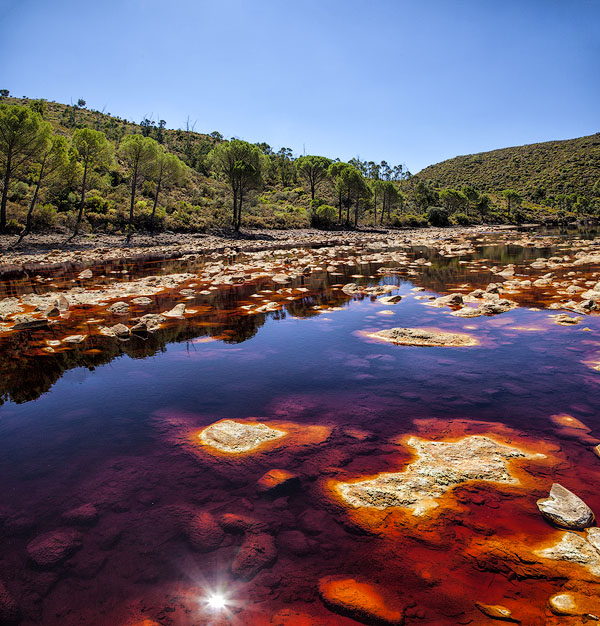
It is important to note that this is not a river polluted by human activity. It emerges from the depths of the Earth already with these characteristics. In fact, the extensive mining activity in the region over more than 5,000 years is due to the peculiar properties of the soil, which are reflected in the river. It was originally known as Hiberus, later as Urium under Roman rule, and later by the Arabs as Saquia or Azequia (meaning irrigation).
The river maintains these properties for about 31mi50km, along which its waters take on shades of red, orange and yellow. Its chemistry gradually changes as it mixes with other rivers and streams, eventually flowing into the Atlantic Ocean near Huelva.
Its characteristics stem from the Iberian Pyrite Belt, which stretches from the Alentejo to the Seville region — an important mineral deposit of pyrite whose formation is estimated to date back 350 million years.
Mining
The land here has been exploited since ancient times — long before the Roman era — though it was during that period that mining reached significant scale. Around 50 mines were created along a 62mi100km stretch to extract gold and silver for roughly 200 years.
However, it was in the late 19th century, with the acquisition of the mines by the British Riotinto Company Limited, that the region underwent major transformation. In 1873, construction of the railway began, and new chemical industries were established as the deposits were developed. In the port of Huelva, a 3822ft1165m iron pier was built to load minerals onto ships.
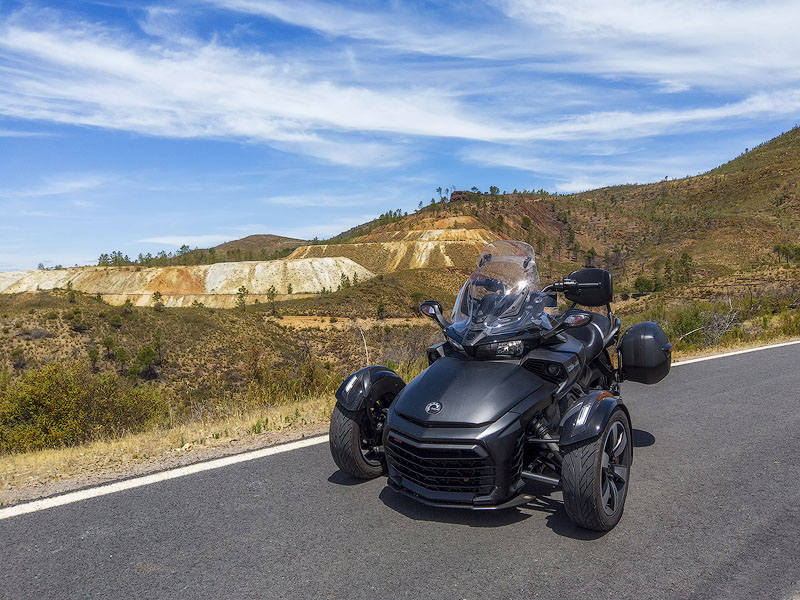
The extraction of sulphur, copper and other minerals continued until the gradual decline in the commercial value of pyrite, caused by the low‑cost production of sulphur in the petroleum extraction industry (1970s). Copper extraction ceased in 1985, though gold and silver mining continued. By the end of the 20th century, many mines and open pits were flooded due to lack of drainage, and in 2001 the mines were finally closed.
With the recent rise in copper prices, mining resumed in 2016 under the newly formed Cypriot company Atalaya Mining. Focused on copper production, its main mining asset today is the Riotinto Mining Park.
What to see
Minas de Riotinto is the town that takes its name from the mines and serves as the main population centre of the Mining Park.
A highlight is the Mining Museum, an absolutely essential visit. In addition to providing rich geological and historical context about the region, it features a fantastic recreation of a working Roman mine.
Also recommended is a visit to House 21 in the former English neighbourhood of Bella Vista, where the management of the Riotinto Company Limited once lived. Built in 1885, it is in excellent condition and is a remarkable example of a colonial‑style residence, showing how the English lived here at the time.
Just over 3mi5km away lies Nerva, another municipality that grew thanks to its proximity to the Peña del Hierro Mine.
Nerva has a dense urban layout. Notable landmarks include the emblematic ayuntamiento (town hall), the monumental La Réu Fountain, and the Daniel Vázquez Díaz Museum of Modern and Contemporary Art, which exhibits works by this important 19th‑century avant‑garde painter born in the municipality.
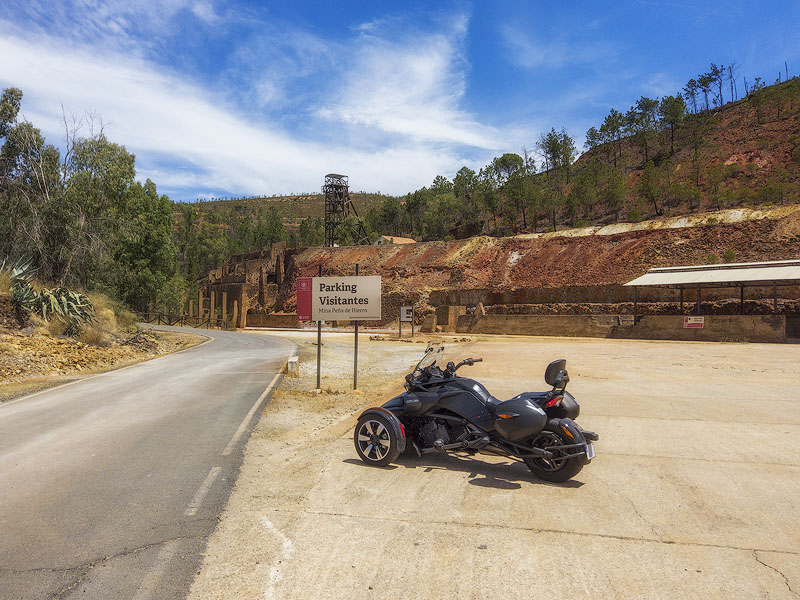
A short distance away is Peña del Hierro, a decommissioned mine with a perfectly preserved (and visitable) gallery that ends at an incredible artificial pit lake approximately 279ft85m deep.
Near Nerva you will also find the tourist train, which travels about 7mi11km along the banks of the Rio Tinto, in a fantastic landscape that looks as though it belongs on another planet.
In Minas de Riotinto, it is possible to purchase a combined ticket that includes:
- entry to the Riotinto Mining Museum
- entry to House 21 in the English neighbourhood of Bella Vista
- a visit to the gallery of the Peña del Hierro Mine
- the tourist train journey along the Rio Tinto, departing near Nerva (about 14mi22km round trip)
Leave a message