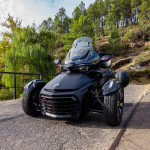
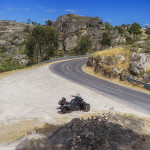
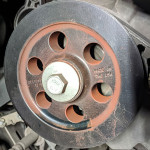
Two years with the Thing
September 2020
Second-year update of the Thing, which was also a completely atypical year and will surely figure in the history books.
So then, this past year we rode a total of 4,971mi8,000km with the Spyder… exactly half of what we did the year before. Until mid-March 2020 (state of emergency declared on the 18th) we kept our usual pace, enjoying sunny weekends. At the end of February we took advantage of the Carnival holidays for a four-day trip through the Aldeias do Xisto (Schist Villages) — and it felt great.
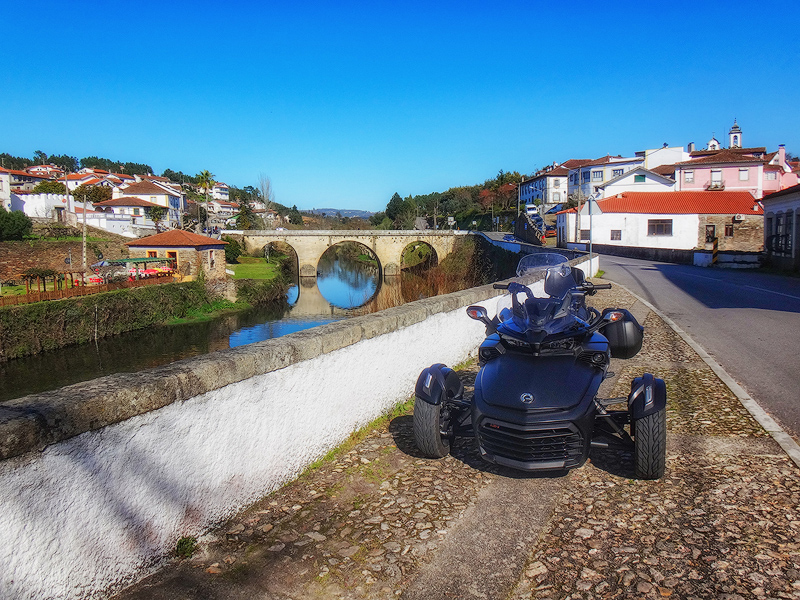
And then came the pandemic and lockdown. The Spyder stayed parked in the garage, only going out for a timid ride (about 50 km) at the end of May, when it was finally allowed.
A trip to the Pyrenees was planned for June, but given the pandemic situation in the neighboring country we thought it best to postpone.
So in June we went back to short day rides and arranged a brief meet-up at Cabo Espichel with other Spyder riders.
But fear lingered, and we avoided going far, staying overnight, or eating out at restaurants.
In August we reserved a week just to ride the Spyder and make up for lost time…
We stayed in Figueira de Castelo Rodrigo at family’s house, and from there did three circuits: the Northeast of Trás-os-Montes, the Historic Villages route, and the Serra da Estrela. We had a bit of bad luck in Trás-os-Montes, where rain accompanied us for half the route. Even so, it was worth it — we were amazed by the beauty of the Terra Fria (Cold Land) and eager to repeat the trip in better weather. Serra da Estrela and the Historic Villages route didn’t disappoint either, though they were places we already knew, just never visited with the Spyder.
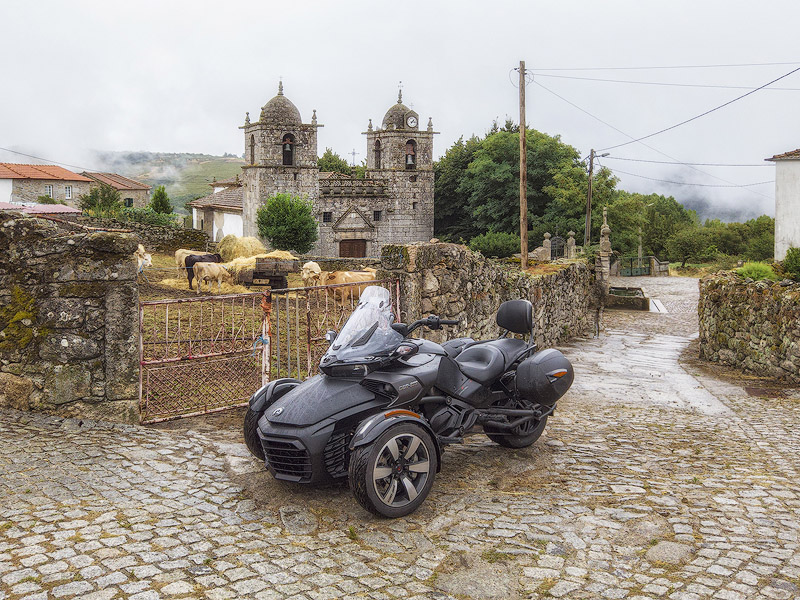
The Spyder was always up to the task, whether cold or hot, rain or sun. In Trás-os-Montes it went everywhere — not even uneven granite cobblestones stopped us (with the occasional scrape of the "nose") from exploring the streets of some timeless villages.
At the end of May, at 12,427mi20,000km, even after lockdown ended, it was necessary to replace the rear tire. It could have lasted another 621mi1,000km or 1,243mi2,000km, but since the rear brake pads were at their limit, everything was changed at once. The replacement was done at Benimoto, of course. I even tried to get the new tire model (Kenda Kanine KR20) that had just arrived in the American market, but the importer must still have a large stock of the old model (Kenda KR21), so that’s what they provided (and at the time it was still the one fitted on new Spyders). The new model is also specific to the Spyder, but is said to have better performance and durability.
12,427mi20,000km isn’t impressive in terms of durability. True, it’s not a car tire (despite the shape), but it seems too "soft". I always kept the rear tire at the recommended pressure (28 PSI), yet the wear was concentrated in the middle. It feels like it balloons when rolling. Some riders don’t even reach 6,214mi10,000km with this tire, while others exceed 18,641mi30,000km before replacing it. In that respect, it’s just like motorcycles: riding style and weight influence tire life.
And if 12,427mi20,000km isn’t surprising, what’s truly disappointing is the price… 250€. Sure, the machine is exclusive and the tire is too, but these prices are in the "premium car tire" range. I wouldn’t mind paying that for an exceptional tire — which these Kendas are not. From 11,185mi18,000km onward the tire started slipping easily, which is why I didn’t push it to the limit. So, can a car tire be used instead? Yes! But opinions are divided: some say absolutely not, others claim it’s the best option. One thing is certain: this KR21 will be the last. Let’s see the feedback on the new KR20s, and maybe even a good car tire with the same dimensions.
Back home, with the tire replaced, I noticed the belt was wandering a bit, when it should be flush or no more than 1 mm from the inside of the rear sprocket. It was clearly misaligned, the result of the axle being moved. I could have taken the Spyder back to Benimoto, but I preferred to do the work myself, having read up on the subject. The axle has two adjusters: one on the left (for tension) and one on the right (for alignment). When tightening, the axle tends to move forward on the right side, affecting alignment. On the Spyder this was obvious, as the right adjuster was loose, meaning the axle wasn’t pressed against it. So I just had to loosen the axle, retighten it while ensuring it stayed against the adjuster, then torque everything to spec. I also retightened the brake calipers, which seemed to have been not tightened to spec. The only thing left was to check belt tension. I ordered a tension gauge and confirmed it was correct (about 244Nm). Typically, if you don’t touch the adjusters, nothing changes when removing the axle — you just need to ensure it’s pressed against them when retightening.
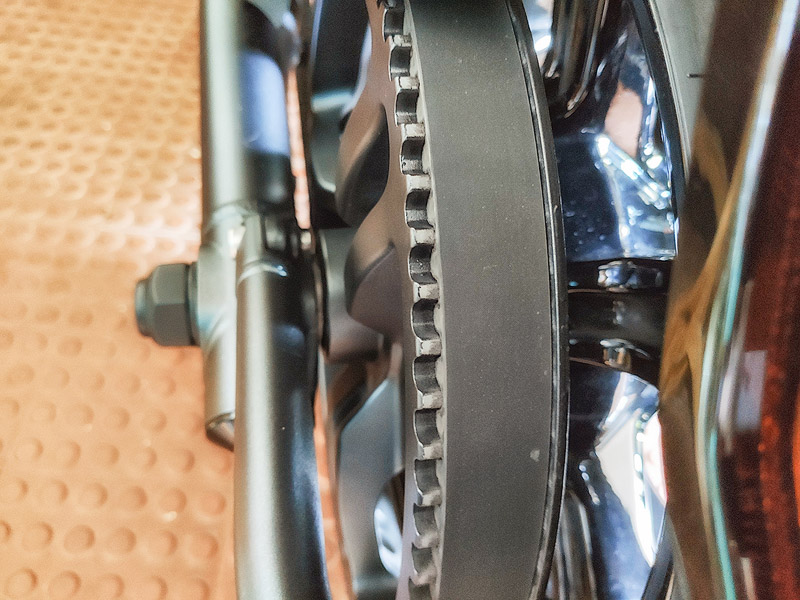
As for the brake pads, they were truly at the end, slightly below the recommended minimum thickness. They were replaced with another set of originals (Brembo) at a cost of €55, which seems fair. Nothing unusual about their lifespan: the brakes work hard, especially since the gearbox is semi-automatic and, although manual downshifts are possible, most of the time I let the gearbox do it, so there’s much less engine braking. Interestingly, unlike motorcycles (where I always replaced two sets of rear pads for every front set), the Spyder’s system wears quite evenly, with the front pads lasting only a little longer.
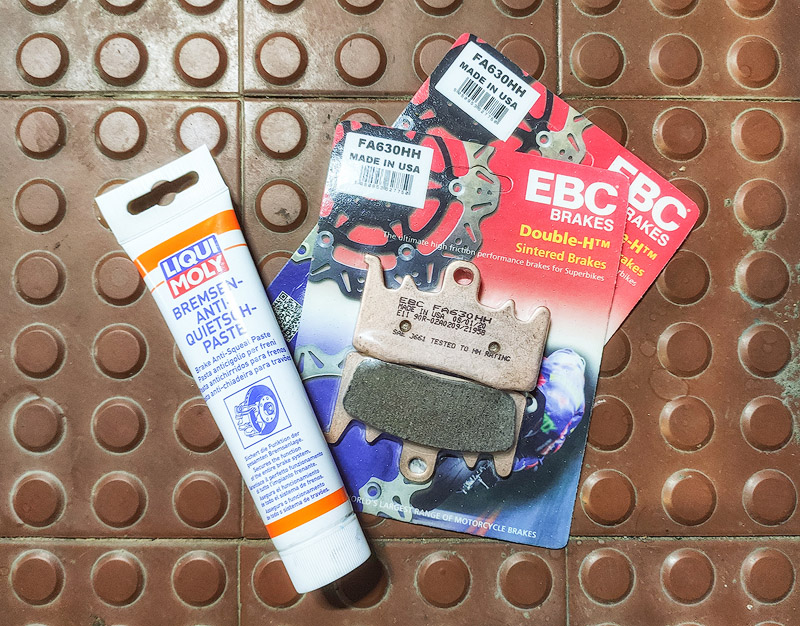
The front pads were nearly at the minimum before our August trip up north, so I decided it was best to replace them (at around 13,670mi22,000km). Benimoto was closed for holidays, so I rolled up my sleeves and tried a different set: EBC pads, very popular and recommended by many. Fully sintered (not organic), they perform better in varied conditions of rain or high temperature. The swap was quick — the hardest part is lifting the Spyder and removing the wheels. I also used a special paste to eliminate brake squeal often heard on hot days (and so far it seems to work), applied between the pad and piston.
The Thing will also need a service. This year more for time than mileage (remember, services are annual or every 9,321mi15,000km. I’m undecided whether to do the oil change myself — I’ll see if I can get a kit from Benimoto. In any case, since there’s still plenty of mileage left before the 9,321mi15,000km limit, there’s no rush.
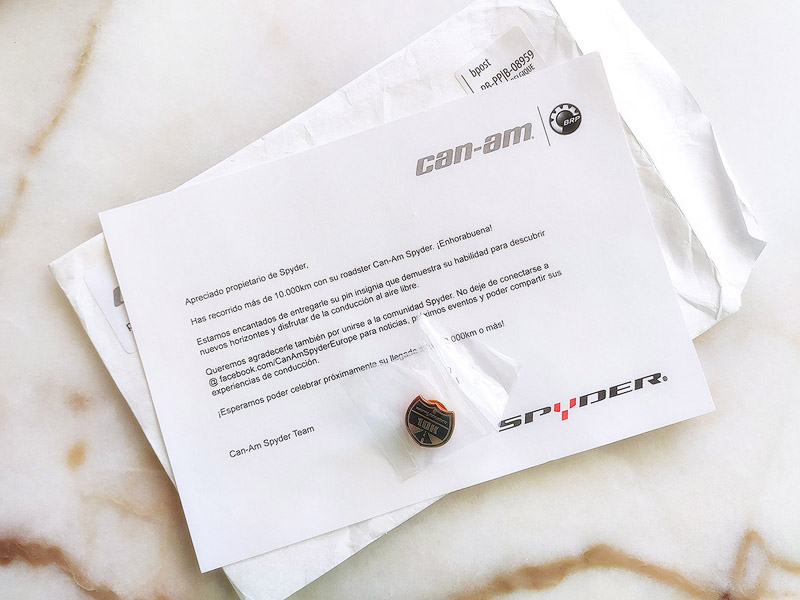
A quick note on the Spyder Pin Program. A nice gesture from the brand, offering customers (upon proof) a pin at 6,214mi10,000km, 31,069mi50,000km, and 62,137mi100,000km. We requested the 6214mi10000km pin, the only one applicable for us right now (though we’ve already doubled that). We thought the program didn’t apply to Portugal, but we were wrong. After about a month, a letter and the pin arrived at home. Very kind of BRP, even if the letter was written in Spanish.
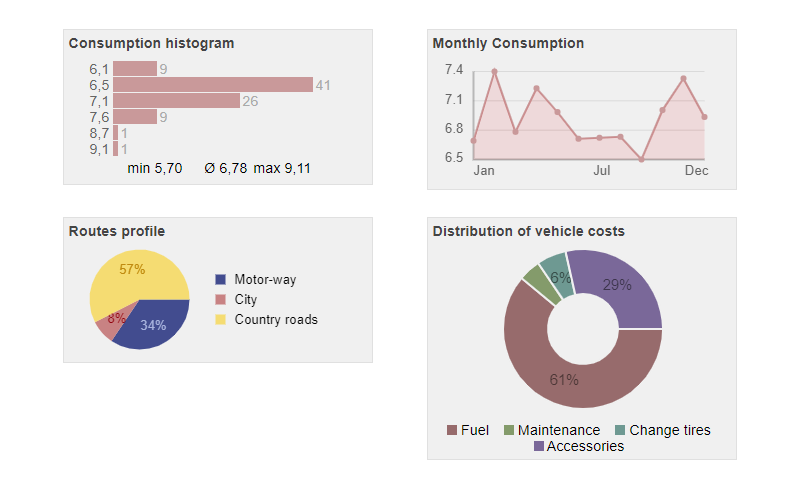
As for the Spyder, nothing to complain about. No mishaps so far, and it continues to give us memorable moments… Fuel consumption remains the same: around 34.9 US MPG/42 UK MPG/6.75L per 100 km. Remember, more than 90% of riding is two-up (together not less than (unit 150 from: kg to: lb thousands: ,) of load), with a good amount of motorway riding — inevitable living in the Lisbon region. In the last 1,864mi3,000km we reactivated ECO mode, with a more conservative throttle map and gearshift indicator. I must say consumption is noticeably lower (about 0.13 US gal/10 UK gal/0.5L less), but only on national roads. On motorways I don’t think the difference is significant, as consumption increases to 33.6 US MPG/40 UK MPG/7L per 100km.
In short, the only regret is not having enjoyed it more. Let’s see what the rest of the year brings and how the next one will be. For now, we’re managing the situation as best we can, riding around Portugal whenever possible
Leave a message