The Thing
August 2018
And so… it was just a matter of waiting a few more days for the baby to arrive, get prepared, and off I went to pick up the Spyder.
Five-star treatment at Benimoto, the Can-Am dealership. Everything perfect, both in timing and in customer care. It’s worth noting that I have no sponsorship or benefits — this writing is done freely and without commitments to anyone.
So there I was, riding it home, slowly… And at the very first roundabout I nearly soiled my pants. Remember, I was taking the Spyder home and at the same time doing the test drive, since I hadn’t yet had the chance to ride such a thing.
I had already read about the jolt you get in corners, but hadn’t yet felt the intensity… Plus the fact that you don’t lean the handlebars but actually have to turn them… I almost went straight out of the roundabout. Then I hit a few more curves and quickly recalled everything I had read about riding the Spyder, and put the theory into practice.
Because the steering is on the front axle with two wheels, the handlebars are very dynamic. All the road feedback is transmitted to them, and they follow the road’s angle. This means that when the road has a strange camber or slope, the whole front end aligns with it — something that doesn’t usually happen on two wheels. For this reason, you should avoid gripping the handlebars too tightly, letting them float instead.
The way it corners is a mix between a quad bike and a go-kart. It turns with the aggressiveness of a kart, but at the height of a quad. In tighter, faster corners you really need to adopt a proper posture. Otherwise, there’s a good chance of being thrown off.
In that case, to make it work, you need to corner sidecar-style: lean your body into the curve, press your inside knee against the tank, and push down on the outside footpeg. On the handlebars, the outside arm pushes and controls, while the inside arm stays bent. You can adjust the trajectory at any time by pulling or pushing with the controlling arm. It may sound complicated, but it isn’t at all. In fact, it feels very natural… And how fun is this?! My goodness…
Cornering on a motorcycle is fantastic, but most corners are taken in a routine way (unless you ride like Valentino Rossi every time). With the Spyder, I’d say more than half are pure madness! Any roundabout is done with a grin, and hairpin bends are a joy (usually a pain on two wheels).
Still, they’re different and incomparable. The Spyder isn’t a motorcycle, and its biggest difference is precisely in how it corners. It’s not the same or even similar — it’s completely different, but no less fun. The lack of lean means the distribution of forces makes every corner an intense experience.
Some say the transition is harder for those coming from two wheels. In my case, apart from cornering dynamics and reaching for the non-existent brake lever a few times, the adaptation was very natural.
Speaking of brakes: on the Spyder it’s all done with a single pedal under the right foot. Stopping power comes from three Brembo calipers on the three wheels.
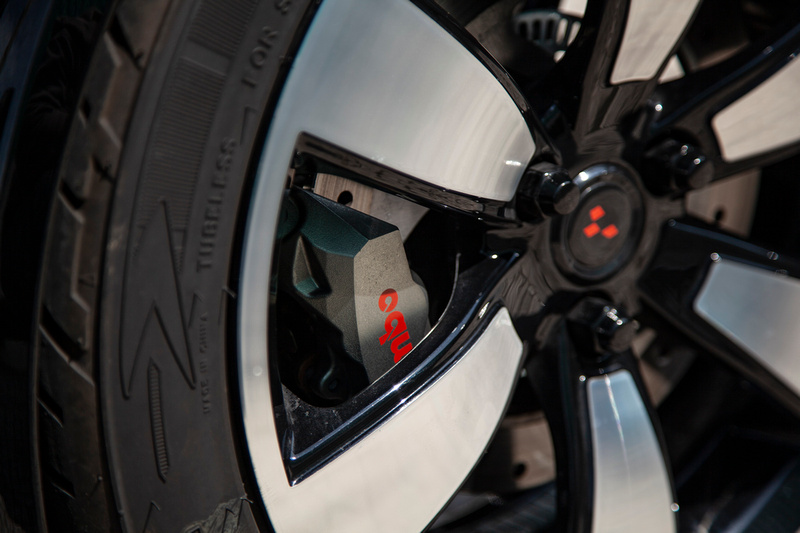
As expected, braking is better than on two wheels… And it really is! The 400-plus kilos feel light when you press the pedal. Braking is well modulated: the first half of pedal travel is for assistance, the rest stops the vehicle immediately. Having it all under one control makes it easy to combine and distribute braking. And having it underfoot makes more sense to me, since you can apply much more force with your leg than with your hand.
Despite being heavy (around 400kg), the Spyder has a lot of lateral movement, much more than a motorcycle. This is surely due to the two-wheel steering and its low stance (firm suspension).
Another aspect is how much you feel the road. A motorcycle has one line of wheels, a car has two, and a trike has three… So if there’s a pothole, the Spyder will almost certainly find it. And worse, if you can avoid it, don’t hit it with the rear wheel — that’s the one right under your backside.
Now, about one of the reasons I switched: riding with a passenger. Well, it’s exactly what I thought: carrying a passenger has zero influence on the handling… You don’t feel it at all. Not in a straight line, not in corners. The dynamics don’t change. Actually, one thing does: under the passenger seat there’s a button triggered by their weight. This tells the Spyder there’s a passenger, so the stability control system kicks in earlier. You notice this in tight corners taken aggressively, where the Spyder stabilizes itself by braking the inside wheel (to prevent the outside one from lifting).
Supposedly (according to the technician) the engine also becomes more responsive in this situation (probably to compensate for the extra weight), but I can’t confirm that — the engine is always generous once you open the throttle.
And of course, like any proper trike, it has reverse gear, making any maneuver safe and simple. Note that on the Spyder reverse is real and mechanical, unlike the usual solutions on big touring motorcycles that use an electric motor or the starter.
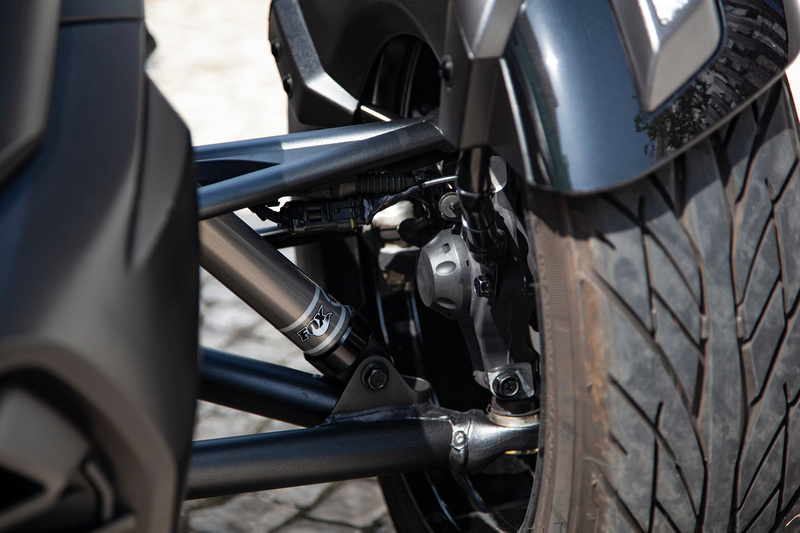
As for two-up riding, the front FOX sport suspension is OK, but the rear is a disaster. It’s not even adjustable and, while fine solo, it’s clearly weak with a passenger, bottoming out frequently. It’s true that several suspension upgrades are offered. Still, with a declared maximum load of 199kg (easily covering two people), it’s hard to understand why such a premium vehicle comes with such a weak rear shock. I only rode a few miles/kilometers with the stock shock. I replaced it with one from Shock Factory, built in France/England. The spring is calibrated at the factory for the desired load, and the shock can be adjusted with a single knob offering 48 clicks.
Problem solved: 6 clicks for solo riding, 16 for two-up, and a few more depending on luggage weight. Perfect.
Finally, not everything is rosy: the windshield accessory (Blue Ridge windscreen) doesn’t fully do its job. Remember, the F3-S comes without a windshield, with two optional ones: a shorter (39 cm) and a taller (54 cm). I installed the taller one, which deflects wind well except at the top of the helmet. That upper edge leaves the helmet exposed to nasty turbulence. At higher speeds, you get strong buffeting. Only shorter riders will be comfortable. I solved it by adding a 10 cm deflector at the top (MRA X-Creen Touring deflector).
And is it fast? Oh yes! The three-cylinder, 1,330cc engine with 115hp and 130Nm launches the 400kg from 0 to 100km/h in about 4.5 seconds — roughly the performance of motorcycles between 600 and 900cc. With the advantage of not being affected by passenger or luggage weight, and even pulling harder above 100km/h.
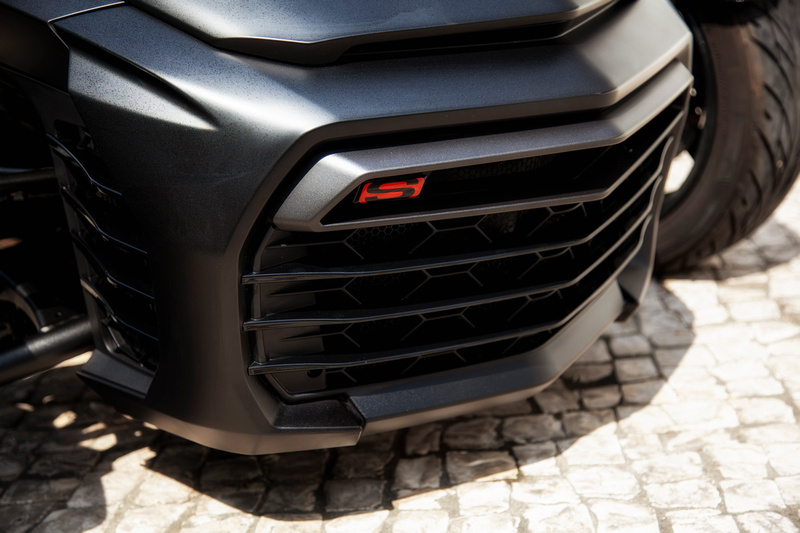
The engine is Austrian, brand Rotax (owned by Can-Am), designation ACE (Advanced Combustion Efficiency), introduced with the F3 in 2015. It’s a three-cylinder dry-sump engine with hydraulic valves and low maintenance (service every 9,321mi15,000km). Tuned for efficiency, it allows a maximum range of 252mi406km at a constant 100km/h with its 27l tank, averaging about 6.65L/100km. Real-world consumption from my experience is around 6.5L/100km on calm national roads and 7.5L/100km on highways at 120km/h, always with a passenger. For a vehicle of this size and weight (882lb400kg), consumption is very reasonable, thanks to efficient engine management and the sixth gear acting as overdrive.
Coupled to this is a six-speed semi-automatic hydraulic transmission (SE6) — a gem!
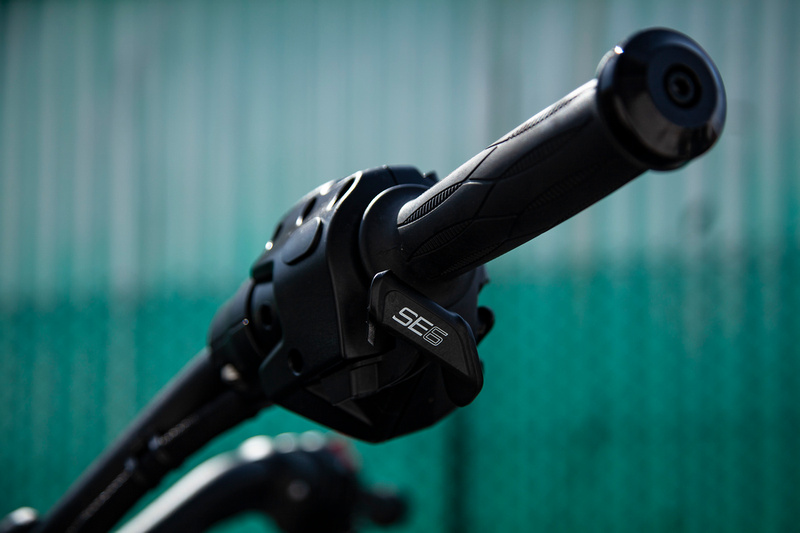
Gear changes are always triggered by the paddle on the handlebar. Downshifts can also be done manually, or automatically if you don’t. Shifting is smooth, as the electronics handle everything: cut fuel, engage gear, and reapply throttle at the right rpm — all in milliseconds. Downshifts are automatic if desired, and when stopped the machine is always idling in first, ready to go. Wonderful.
Final drive is by belt, something I wasn’t used to. Advantages: zero maintenance (except alignment when needed) and, if treated well, it lasts a lifetime (over 100,000km). Disadvantages: it vibrates at certain speeds, is very expensive (400–500€), and can be damaged if a larger stone gets lodged between it and the wheel pulley.
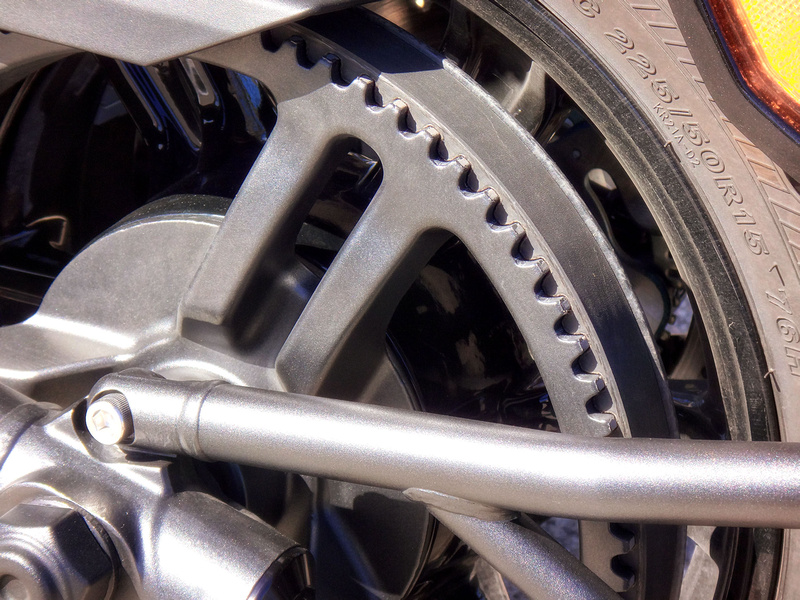
The Spyder’s belt is huge. It vibrates between 100 and 110km/h. Belt tensioners can be fitted to eliminate this… At first it bothered me, but now I don’t mind. To avoid damaging the belt, just don’t take the Spyder on rough roads — it doesn’t like them anyway, given its low ground clearance.
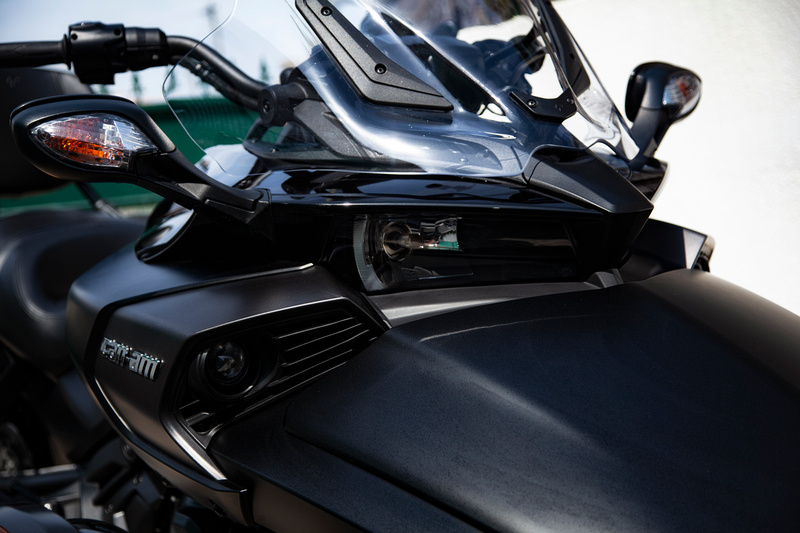
Finally, in terms of assembly, materials, and finish, it’s above some Japanese bikes and on par with any European. The build is solid, flawless. Functionally, it’s clearly well thought out. As for design… well, that’s subjective, but personally I think it’s stunning, it ticks all my boxes. The front is aggressive and muscular, and the rear wide and short, fully inspired by the bobber style. In my view, the Canadians carried out a commendable exercise in design… Applause!
And that’s pretty much it…
Leave a message