Can-Am and BRP
It is the Canadian company BRP (Bombardier Recreational Products) that produces and markets the vehicles of its Can‑Am division.
Can‑Am is dedicated to the production and commercialization of on‑road vehicles (two‑ and three‑wheelers) and off‑road vehicles — all‑terrain quads (ATV, All Terrain Vehicle) and SSV (Side‑by‑Side Vehicle).
The BRP group also includes the following brands:
Sea‑Doo: personal watercraft.
Ski‑Doo and Lynx: snowmobiles.
All engines used by the group are produced by Rotax, headquartered in Gunskirchen (Austria), which is also part of the BRP universe.
Rotax also manufactures engines for motorcycles, karts, light aircraft and small boats.
In 1937, Canadian mechanic Joseph‑Armand Bombardier created, in his workshop in Valcourt (Québec, Canada), the first passenger snow vehicle and registered its patents.
Later, in 1942, he founded L’Auto‑Neige Bombardier Limitée, and in 1959 he invented the famous Ski‑Doo, a revolutionary snowmobile (for one or two people) with a rubber track system that proved more efficient and faster than the traditional metal tracks used until then.
The vehicle was originally called Ski‑Dog (a reference to sled dogs), but a spelling mistake resulted in Ski‑Doo, the name under which it became popular.
1964 | Joseph‑Armand Bombardier dies at age 56 from cancer. His sons and sons‑in‑law ensure the continuity of the business, decentralizing and modernizing the company. |
1966 | His son Germain Bombardier sells his stake after disagreements within the family. It is his son‑in‑law Laurent Beaudoin who assumes the presidency of the company until 1999. |
1968 | American inventor Clayton Jacobson II creates the first personal watercraft (jet ski) and enters a licensing agreement with Bombardier. The first jet ski under the Sea‑Doo name is introduced, but due to technical complications it remains on the market for only two years. |
1970 | Acquisition of the Austrian engine manufacturer Rotax. |
1972 | Can‑Am is founded and begins operations producing motocross (MX) motorcycles. |
1987 | Final year of Can‑Am motorcycle production. |
1988 | Acquisition of part of the Finnish company Nordtrac, a successful snowmobile manufacturer in the sports segment, selling under the Lynx brand. |
1993 | Bombardier acquires full ownership of Nordtrac and incorporates the Lynx brand into the group. |
1998 | After an 11‑year hiatus, Bombardier Inc. returns to the off‑road vehicle market, this time with a quad (Traxter 500). |
2001 | Acquisition of the Evinrude Outboard Motors and Johnson Outboards brands, both part of the Outboard Marine Corporation group (declared insolvent), manufacturers of outboard engines for small boats. |
2003 | The recreational products division becomes independent under the name Bombardier Recreational Products (BRP). The new owners are the American fund Bain Capital (50%), the Bombardier‑Beaudoin family (35%), and the institutional investor La Caisse de dépôt et placement du Québec (15%). |
2007 | The off‑road vehicle line begins to be marketed under the Can‑Am brand, which will also produce the Spyder. |
2013 | BRP is listed on the Toronto Stock Exchange, ticker: TSX:DOO. |
2020 | Closure of Evinrude Outboard Motors, marking the end of BRP’s outboard engine business. |
2025 | José Boisjoli (CEO) retires after 36 years with the company and 22 years leading BRP. |
2026 | Denis Le Vot becomes CEO of BRP. |
Can‑Am was originally founded in 1972 as a subsidiary of the Bombardier Corporation. The name combines the words Canada and America, clearly defining its target markets.
The brand began by producing an off‑road competition motorcycle equipped with a Rotax two‑stroke engine. The motorcycle used a lightweight, rigid universal frame capable of accommodating different engine sizes (between 175 cc and 400 cc).
Success was immediate: in 1974, Can‑Am swept the podium at the AMA 250 National Championship, taking 1st, 2nd and 3rd places — a shock to the Japanese manufacturers.
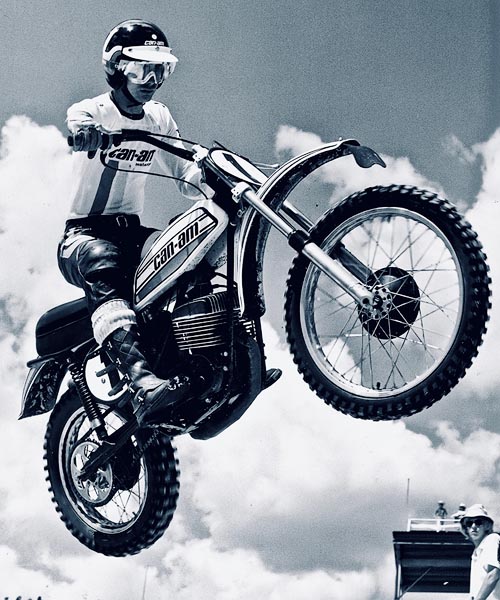
Production ran from 1972 to 1987, with the MX motocross line, the Qualifier enduro line (famous for being nearly indestructible), and the more recreational Trail N’ Track (TnT) line for trails, road and amateur competition.
In the early 1980s, the brand attempted modernization with the Sonic line (or ASE), produced under license by Armstrong/CCM in England. Despite improvements, the market was dominated by Japanese brands, and Can‑Am ended motorcycle production in 1987.
More information about this period at Canned‑Ham.com
In 1996, at BRP’s annual ADF (Annual Design Forum), the first sketches of what would become the brand’s first on‑road trike were presented.
In 1998, Bombardier introduced two 4×4 ATVs with Rotax engines: the Traxter 500 and, later that year, the DS650 (Dune Sport), the first being a utility model and the second a more sport‑oriented machine.
In 2002, the Traxter MAX was launched, the first two‑seat ATV.
The DS650X won the Dakar Rally in the quad category in 2004 (Cornel de Villiers) and 2005 (Antoine Morel).
In 2006, the Outlander 800 was introduced, the brand’s first ATV with a V‑twin engine. One year later came the Renegade 800, another large‑displacement ATV, lighter, more aggressive and sportier.
In 2007, BRP rebranded its entire ATV line under the Can‑Am name.
A year later, a second factory opened in Juarez, Mexico, dedicated to off‑road vehicle production.
In February 2007, the first three‑wheel model was announced under the name Can‑Am Spyder Roadster.
It was officially launched in the United States at the Miramar Air Base (near San Diego) and featured in the February 4th edition of the New York Times and the February 5th edition of the Los Angeles Times.
This marked the creation of the Can‑Am Off‑Road and Can‑Am On‑Road lines.
The idea came from adapting a Ski‑Doo snowmobile by adding wheels.
This is precisely the basis of the Spyder chassis: the Y‑Architecture or Y‑Frame, where the two‑wheel axle is at the front (instead of the rear), classifying it as a reverse trike.
It was not the first vehicle of this type, but it was the first well‑engineered and mass‑produced one.
The concept began development at BRP in the early 2000s, with the goal of entering the on‑road market without competing directly with motorcycles — a saturated segment where BRP would struggle to establish itself.
The goal was to design a vehicle more stable and safer than a motorcycle, exciting to ride, but accessible to new riders and to people with physical limitations preventing motorcycle use.
The Can‑Am Spyder Roadster is characterized by:
Two front wheels, providing greater precision, stability and braking performance (most braking force is applied at the front).
A wide rear wheel for traction.
A riding sensation between a motorcycle, a kart and a roadster.
Automotive‑grade electronic assistance systems: ABS, TCS, ESC and DPS.
After more than 2,500 confirmed pre‑orders, the first Can‑Am Spyder units were produced in September at the Valcourt, Quebec factory.
The first units reached North America in October 2007 (as 2008 models), with the very first one gifted to Jay Leno, where it remains part of his personal collection.
Since then, the brand has expanded and refined its On‑Road lineup:
2007 | Presentation of the Can‑Am Spyder Roadster model. |
2008 to 2009 | Consolidation of the Spyder GS line with 5‑speed manual (SM5) and semi‑automatic (SE5) gearbox versions. |
2010 | Delivery of the first units of the new Spyder RT line, designed for long‑distance touring. |
2011 to 2013 | Consolidation of the Spyder RT line with new colors and electronic refinements. |
2012 | Delivery of the first units of the Spyder ST line, positioned as sport touring, between the RS and RT lines. |
2014 | Replacement of the Rotax 998 V‑Twin engine with the new Rotax 1330 ACE three‑cylinder engine (only in the RT line). This also introduced the 6‑speed gearbox (SE6). |
2015 | Delivery of the first units of the Spyder F3 line (including the base F3, F3‑S, F3‑T, and F3 Limited versions). |
2016 | Final year of the Spyder RS line. |
2017 to 2019 | Consolidation of the Spyder F3 and Spyder RT lines with improvements to the instrumentation. |
2019 | Delivery of the first units of the Ryker, introduced as a more accessible reverse‑trike option. |
2020 | Complete redesign of the Spyder RT line. |
2021 to 2025 | Consolidation of the F3‑S as a sport touring model, F3‑T/F3 Limited as versatile cruiser touring models, and RT as a premium touring model. |
2023 | Final year of the base F3 version, leaving F3‑S, F3‑T, and F3 Limited for the following years. |
2024 | Delivery of the first Pulse and Origin electric motorcycles, featuring a new and more advanced instrument cluster that also becomes standard across all Spyder versions. |
2025 | Delivery of the first units of the Canyon, introduced as an adventure touring segment proposal. |
The 2010s also marked the arrival of Side‑by‑Side Vehicles (SSV) in the Can‑Am Off‑Road lineup.
In 2010, the Commander 1000 was launched, the brand’s first SSV, equipped with an 85hp Rotax V‑Twin.
Two years later came the Maverick R, with 101hp, designed to compete with the Polaris RZR XP and the Arctic Cat Wildcat.
In 2016, the Maverick X3 was introduced. Designed for competition, it came equipped with a Rotax 900 ACE Turbo RR engine producing 200hp.
The Maverick X3 won six consecutive editions of the Dakar Rally (2018 to 2023) in the Side‑by‑Side (SxS) category.
Present day
As of 2025, BRP:
has annual revenues exceeding 5.6 billion dollars.
has a network of more than 2,800 dealers.
is represented in more than 130 countries.
It employs around 16,500 people across several factories worldwide:
Valcourt, Canada: headquarters, research and development center, and production of Can‑Am On‑Road trikes and Ski‑Doo snowmobiles.
Gunskirchen, Austria: production of Rotax engines.
Juarez, Mexico: production of Can‑Am Off‑Road vehicles.
Querétaro, Mexico: production of Sea‑Doo personal watercraft and Can‑Am On‑Road electric motorcycles.
Rovaniemi, Finland: production of Lynx snowmobiles.
Around 70% of the group’s vehicle production originates from the factories in Mexico and Canada.
Since the first snow vehicle created by Joseph‑Armand Bombardier, the company has continued to innovate in the recreational vehicle sector — arguably its greatest strength and defining attribute.
Any missing or incorrect information, please leave a message below
Leave a message