Ronda
It originates from the Roman city of Arunda, but it was the Arabs who consolidated it and defined its urban layout. Ronda sits on a plateau vertically cut by a cliff carved by the Guadalevín River. The old part of the city is especially picturesque as it lies on the edge of this cliff, about 320ft/100m high. Its monumental ensemble, combined with the natural surroundings and proximity to Málaga, have made it a major tourist center. It is a captivating city that has charmed over time some well‑known figures such as Goya, Ernest Hemingway, Orson Welles, Miki Haruta, and Rainer Maria Rilke, among others.
Below is a list of points of interest to visit in this city.
Puente Nuevo
It is the most emblematic monument of Ronda. Its construction lasted about 42 years, being completed at the end of the 18th century, and until 1839, with its 320ft/98m in height, it was the tallest bridge in the world.
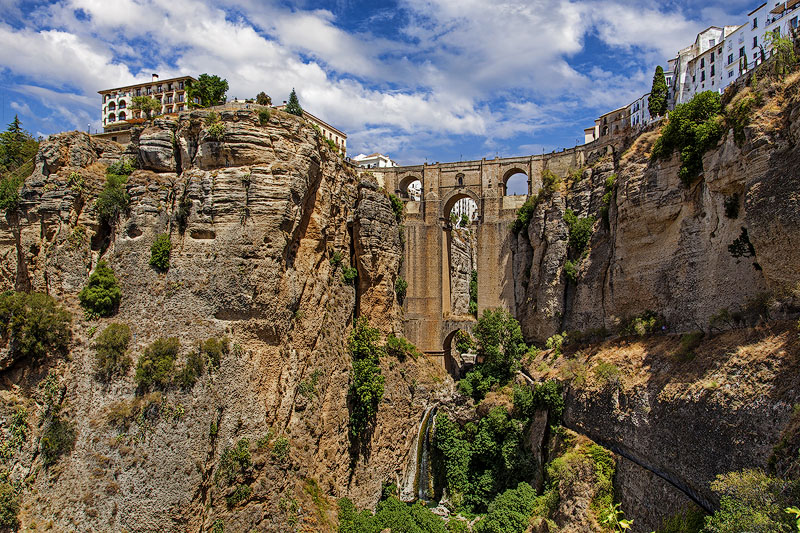
In 1735 the first bridge was built (with a single arch of 115ft/35m), which due to poor design collapsed six years later. Only in 1751 were the works restarted, being inaugurated 42 years later (1793). This time massive lateral supports (320ft/100m high) and a single arch of just 49ft/15m were used. Besides being spectacular, it is an important work as it connects the historic and modern areas of the city, spanning the impressive gorge carved by the Guadalevín River, known as el Tajo de Ronda. Inside the bridge, just below the deck, there is a space that today houses the Interpretation Center of the Environment and History of the City. During the civil war this place was used as a prison and supposed torture chamber, with even some unconfirmed stories indicating that prisoners were thrown from the bridge.
Alameda del Tajo and Paseo de los Ingleses
Today Alameda del Tajo was once of San Carlos. It is a magnificent botanical garden from the early 19th century with a central avenue covered by leafy trees that provide comfortable shelter for those who walk through it. In the garden there are notable trees, some more than 200 years old. For example, a Himalayan cedar, a stone pine, and a honey locust.
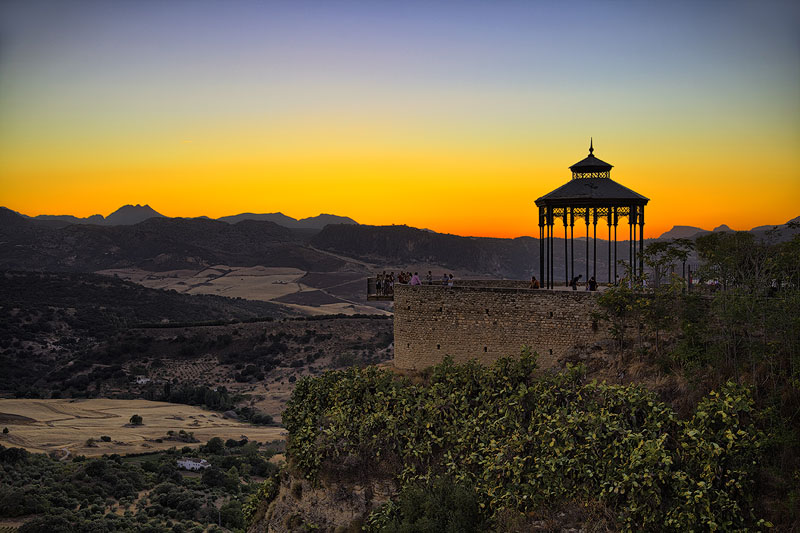
The western part of the alameda leads to the beautiful Paseo de los Ingleses, which runs along the edge of the Tajo cliff, offering grand views from balconies overlooking the Serranía de Ronda. In summer the sun sets behind the hills of the mountains. Watching this spectacle from one of these balconies is a memorable experience. To the south, next to the Bullring, is the garden of Blas Infante. Here you can see sculptures of Ernest Hemingway, Orson Welles, and the Japanese painter Miki Haruta, in homage to these individuals who fell in love with this city. After the garden and before reaching the magnificent Parador de Ronda, there is the viewpoint of La Sevillana (also known as del Coño! viewpoint). A pleasant space composed of a bandstand and an impressive metal balcony suspended over the precipice. A much‑appreciated place to spend an afternoon.
Plaza del Socorro
Located in the urban center of the new part of the city, it is one of the busiest squares for tourists and locals. In addition to a wide range of restaurants, it connects with Calle Carrera Espinel, surely the most commercial and lively street in the city.
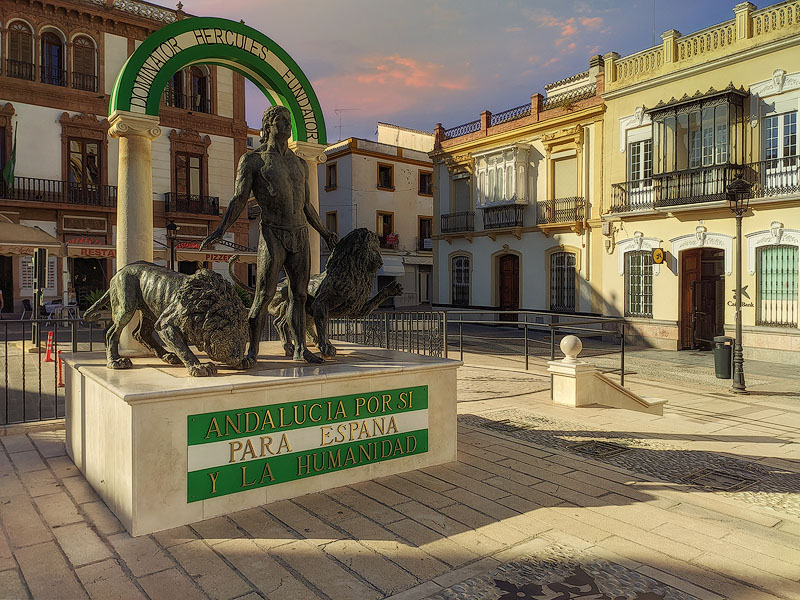
It had to be almost completely restored after the War of Independence against the French (early 19th century). It was at that time that the surrounding buildings appeared, such as the Casino de Ronda (or Círculo de Artistas). The Church of Socorro, which dominates the square, is of more recent construction (20th century), replacing an old hermitage. In the center there is a fountain with a monument to Hercules and a sculpture of Blas Infante, an important Andalusian figure.
Plaza Duquesa de Parcent
Meanwhile renamed, it was once the Plaza Mayor. Located in the old part, it has always gathered the most important buildings of the city – the Town Hall (former Provincial Militia Barracks), the Collegiate Church (Santa María la Mayor, 13th century), the Castle (former Alcazaba), and the convents of Santa Isabel (16th century) and la Caridad (16th century). An important and spacious square with a monumental setting and a leafy garden in the center that invites a pause.
Museum of the Real Maestranza de Caballería de Ronda (Royal Cavalry Order of Ronda) and Bullring
The Real Maestranza de Caballería de Ronda was founded here in 1572 by Philip II with the purpose of defending the territory. Its function was to ensure the training and handling of horses. Among the various equestrian activities were skill games with bulls, which quickly became a spectacle for the population.
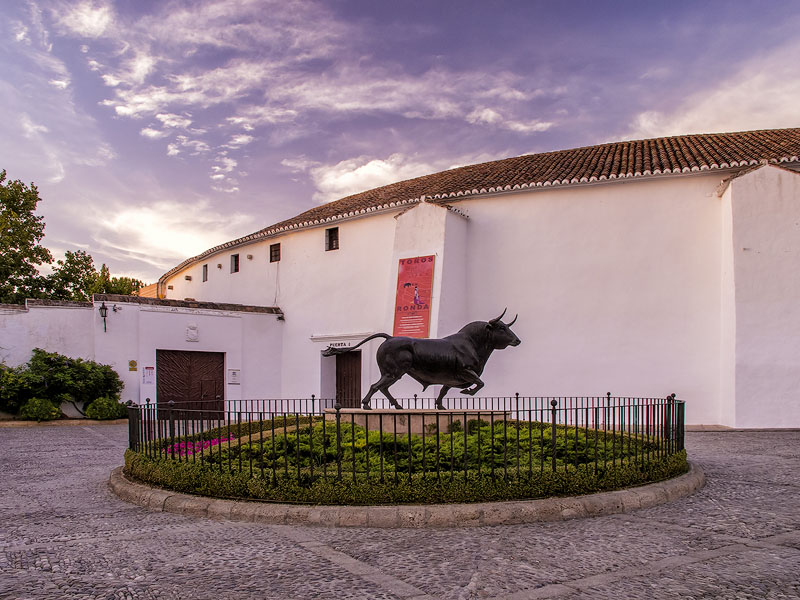
In the 18th century, with the first bullfighters on foot, the Romero family emerged, ensuring three generations of notable bullfighters. The most famous, Pedro Romero (1754–1839), greatly contributed to popularizing bullfighting. The consecration of bullfights took place during the reign of Philip V and was consolidated throughout the 18th century. The bullfighter became professional, and the first bullrings appeared. The construction of the bullring of Ronda was completed in 1785. Owned by the Real Maestranza de Caballería de Ronda, it is considered one of the oldest in Spain. It was used as a barracks by French troops during the invasion. It also served as a concentration camp for republican prisoners of Franco’s troops. Classified as a monument and cultural heritage site, it is closely linked to the more recent history of the city. It currently houses the Museum of the **Real Maestranza de Caballería de Ronda, divided into three parts: Real Maestranza de Caballería de Ronda, origin and evolution of bullfighting, and Ronda in the history of bullfighting. Inside it is also possible to visit the bullfighting museum, the Royal Harness Workshop of the House of Orléans, and a collection of old firearms.
Arab Baths of Ronda
One of the best‑preserved examples in the Iberian Peninsula. Located next to the Arab bridge and the current San Miguel neighborhood, a place that would have been on the outskirts of the old Andalusian Medina of Ronda. Their construction took place in the 13th to 14th centuries, next to the Ribeira de las Culebras. They are divided into three areas according to the Roman model: cold, warm, and hot waters.
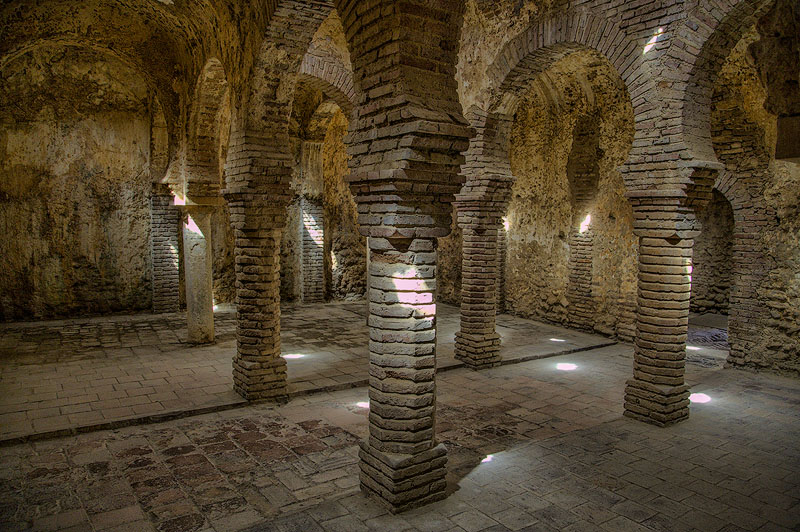
The domes forming the ceiling of the main hall are filled with small star‑shaped skylights that illuminate the interior. An aqueduct outside carried water from the tower (where the waterwheel is still perfectly preserved today) as well as to the boiler area where the waters were heated. It is also possible to see part of the tanneries that were installed there after the baths were abandoned following the Castilian reconquest. Inside, a very interesting film is shown about their functioning in the Andalusian era.
Mondragón Palace of Ronda
Although little remains from that time, it is originally an Andalusian palace. It is known that in the 14th century it was the residence of King Abd al Malik (Moorish King of Ronda), son of the Sultan of Morocco Abul Hassan. Later Ronda came under the Kingdom of Granada, and the palace became the governor’s residence. In the 15th century, after the Christian Reconquest, it was used by the Catholic Monarchs during their stay in the city, after which it passed into the possession of Captain Melchor de Mondragón, who gave it its current name. The entrance courtyard is from the 18th century, known as the Courtyard of the Well. The second, called the Mudejar Courtyard, is from the 16th century and actually presents a mixture of Gothic, Renaissance, and Mudejar styles. Finally, the third courtyard is in late Gothic style. Today the palace houses the Archaeological Museum of Ronda.
Casa del Rey Moro (House of the Moorish King)
We find this house on a ravine of the gorge formed by the Guadalevín River. The space is divided into three parts: the house, the gardens, and the water mine. The house dates from the 18th century and therefore could never have belonged to any Moorish King. It is instead a creation of the Duchess of Parcent, resulting from several 18th‑century houses.
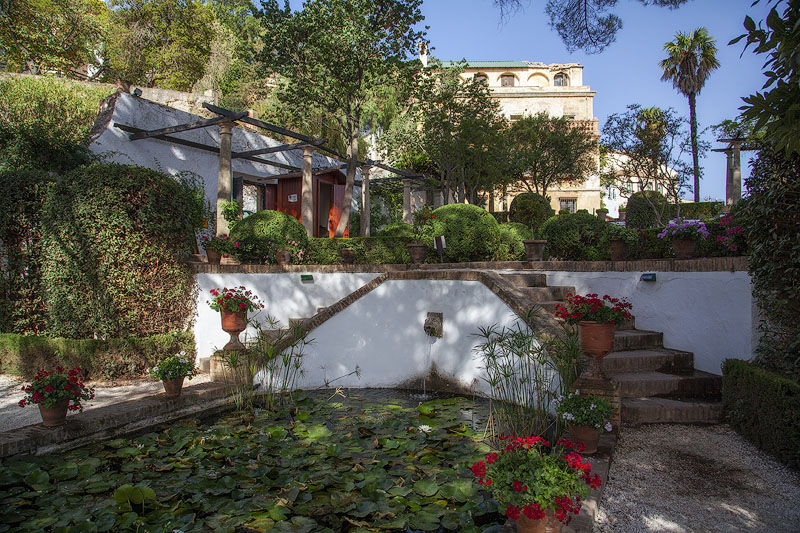
The gardens, which combine Moorish and French elements, are even more recent (1912) and were designed by the French landscape architect Jean‑Claude Nicolas Forestier. The water mine, on the other hand, is one of the best‑preserved engineering works from the period of Moorish occupation. During the 14th century the city was constantly disputed between Moors and Christians, being frequently besieged. It was at that time that Abd al Malik (Moorish King of Ronda) ordered the construction of the mine to supply the city with water from the river.
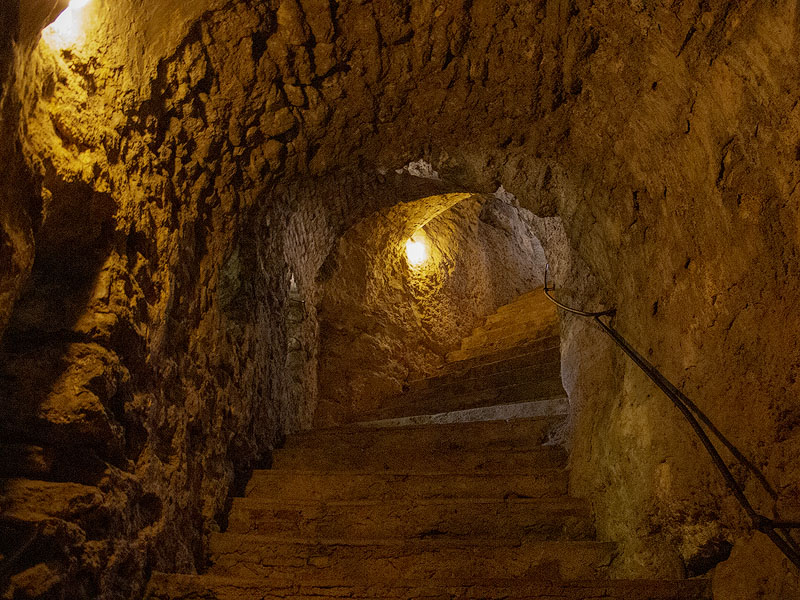
It is a narrow staircase carved into the interior of the cliff wall that allows access to the river with a total drop of about 195ft/60m. The mine was restored in 1911 and currently has about 300 steps (originally there were 365). The house has been under restoration for some years and is, to date, the only element that is not visitable.
Lara Ronda Museum (arts and antiques)
It is located in the historic area of the city, more precisely in the former Palace‑house of the Counts of the Conquest of the Batanes Islands. It was the first private museum in Andalusia. In this case, the private collection of Juan Antonio Lara Jurado, who gathered here the work of a lifetime. The collection consists of more than 2,000 pieces (originals from the 18th to 19th centuries) grouped into themes such as: weapons, clocks, collecting, romantic, scientific, folk arts, and archaeology. Here you can find a bit of everything, from primitive pistols, sewing machines, typewriters, microscopes, and film projectors. The highlight is the lower floor, where objects of torture from the Holy Inquisition are displayed, along with a collection dedicated to witchcraft.
Leave a message