Electric Motorcycles
BRP’s clear intention to transition toward electric mobility dates back to the first Spyder model, when in late 2010 it unveiled a hybrid-powered prototype developed in partnership with the CTA (Centre de Technologies Avancées BRP – Université de Sherbrooke).
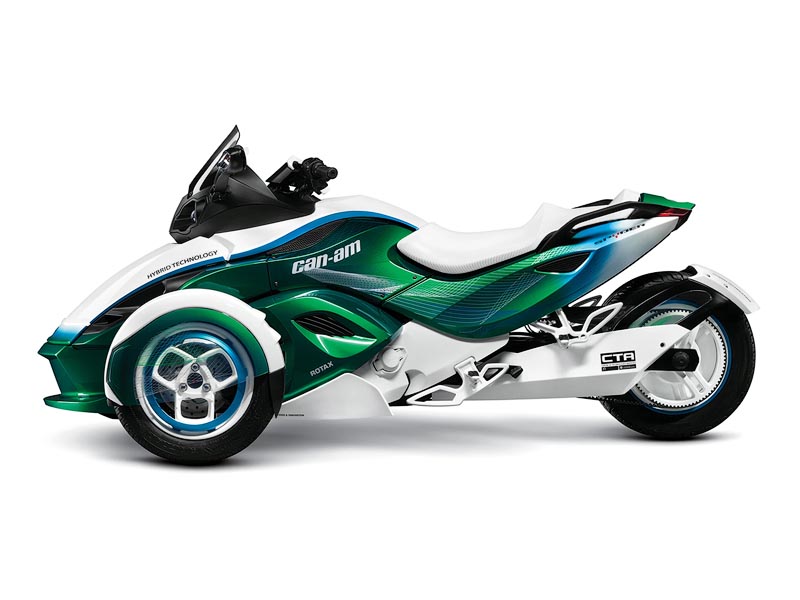
Later, in 2016, BRP reaffirmed this commitment by revealing a fully electric prototype of the Spyder F3, also designed by the CTA.
In 2018/2019, following the bankruptcy of the American electric dirt bike manufacturer Alta Motors, BRP acquired its intellectual property, patents, and some physical assets.
In 2024, BRP announced the relaunch of two-wheeled motorcycles under the Can-Am division, a segment it had exited nearly 40 years earlier (see BRP and Can-Am).
Electrification creates "a market space that cannot be ignored", stated CEO José Boisjoli at the time.
According to BRP, the combustion motorcycle market is saturated, and electric motorcycles present an opportunity to re-enter the segment.
In 2024, two fully electric models were announced: the Pulse and the Origin.
Both feature modern, minimalist designs with clean lines.
The Pulse is a naked street bike, geared toward urban riding. The Origin is a dual-sport model designed for off-road adventure.
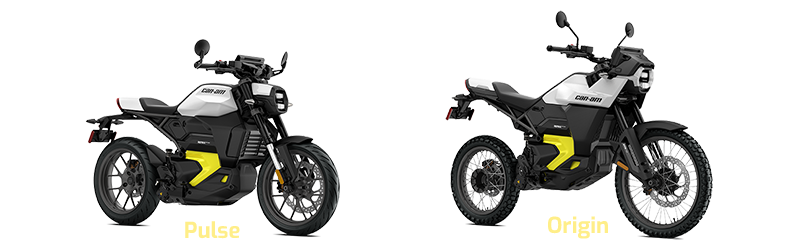
Despite their modest range — just over 62mi100km in combined cycle, typical for the segment — these models are clearly positioned as utility vehicles rather than touring machines.
Technology and Innovation
However, true to the brand’s tradition, Can-Am enters the electric motorcycle segment with its own innovative touch:
Unique cooling circuit — uncommon in electric motorcycles, capable of cooling the battery, electric motor, inverter, and onboard charger, ensuring efficient system performance.
Structural battery — the 8.9 kWh battery is embedded within the frame, not an external pack. This reduces complexity and weight, improves center of gravity, structural rigidity, and balance.
Fully sealed and lubricated final chain drive — quiet, low-maintenance, and well-protected, ideal for the Origin’s off-road capabilities.
Rotax E-Power motor — innovatively mounted inside the swingarm.
Active and passive regeneration — energy recovery during deceleration via reverse throttle input and throttle cut-off, simulating engine braking.
Technical specifications:
Pulse | Origin | |
|---|---|---|
type | naked/urban | dual-sports/adventure |
motor | Rotax E-POWER | |
power | 47hp (35kW) peak, 27hp (20kW) continuous | |
torque | 53.1ft-lb72.0Nm @ 0-4600rpm | |
performance | 80mph129km/h, 3.8s | 80mph129km/h, 4.3s |
transmission | direct drive clutchless, with reverse | |
final transmission | enclosed chain, lubbed | |
cooling | liquid (battery, motor, inverter and onboard charger) | |
battery | integrated lithium-ion, 8,9kWh | |
regeneration | active and passive | |
charging | Type 1 J1772, 6.6kW (Level 1 and 2), 20% to 80% in 50 minutes | |
autonomy | 99mi160km (urban), 81mi130km (combined WMTC) | 90mi145km (urban), 71mi114km (combined WMTC) |
curb weight | 390lb177kg | 412lb187kg |
dimensions | 79.9in2030.0mm x 37.3in947.0mm x 46.1in1171.0mm | 86.8in2204.0mm x 33.9in861.0mm x 55.7in1414.0mm |
wheelbase | 55.6in1412.0mm | 59.2in1503.0mm |
ground clearance | 5.7in146.0mm | 10.8in274.0mm |
seat height | 30.9in784.0mm | 34.1in865.0mm |
maximum load | 333lb151kg | |
front suspension | KYB 41mm inverted telescopic fork | KYB 43mm inverted telescopic fork |
rear suspension | single-sided swingarm, SACHS shock with spring pre-load adjusment | single-sided swingarm, KYB HPG shock with spring pre-load and compression adjustment |
front brake | 320mm disc with JJuan two piston floating caliper | |
rear brake | 240mm disc with JJuan single piston floating caliper | |
front tire | 110/70 R17 | 90/90 R21 |
rear tire | 150/60 R17 | 120/80 R18 |
Official technical brochures:
2025 Can-Am Motorcycles specifications Pulse (EMEA), Origin (EMEA).
2026 Can-Am Motorcycles specifications Pulse, Origin.
Any missing or incorrect information, please leave a message below
Leave a message