Rotax
Rotax, now headquartered in Austria, is a company with more than 100 years of experience in the development of small- and medium‑displacement gasoline engines.
It supplies the powertrains for all vehicles sold by BRP divisions (Can‑Am, Sea‑Doo, Ski‑Doo and Lynx), and also produces engines for karts, ultralight aircraft and LSA (Light‑Sport Aircraft). In the past, it even produced engines for motorcycles from Aprilia, BMW, KTM and MuZ.
Over time, it has established itself as a global reference in compact, reliable and efficient engines.
Timeline:
1920 | Rotax‑Werk AG begins producing engines in 1920 in Dresden, Germany. |
1930 | It is acquired by Fichtel & Sachs and relocated to Schweinfurt in Bavaria. |
1943 | In the midst of World War II, it moves to Wels, Reichsgau Oberdonau, to escape Allied bombings. |
1947 | After the war, it transfers its operations to the outskirts of Gunskirchen. |
1955 | Ownership is transferred to the Austrian state. |
1959 | A majority stake in Rotax is acquired by Lohner‑Werke, a manufacturer of cars and railway carriage bodies. |
1970 | Lohner‑Rotax is purchased by Bombardier Inc. |
2003 | The recreational products division BRP (Bombardier Recreational Products) becomes independent and incorporates Rotax, which supplies all engines for its vehicles. |
998 V-Twin
This is one of the most important power units produced by BRP/Rotax.
It was developed in the late 1990s and used in several vehicles produced by the brand, such as snowmobiles, jet skis, quads, side‑by‑sides, and in the first Spyder in 2007.
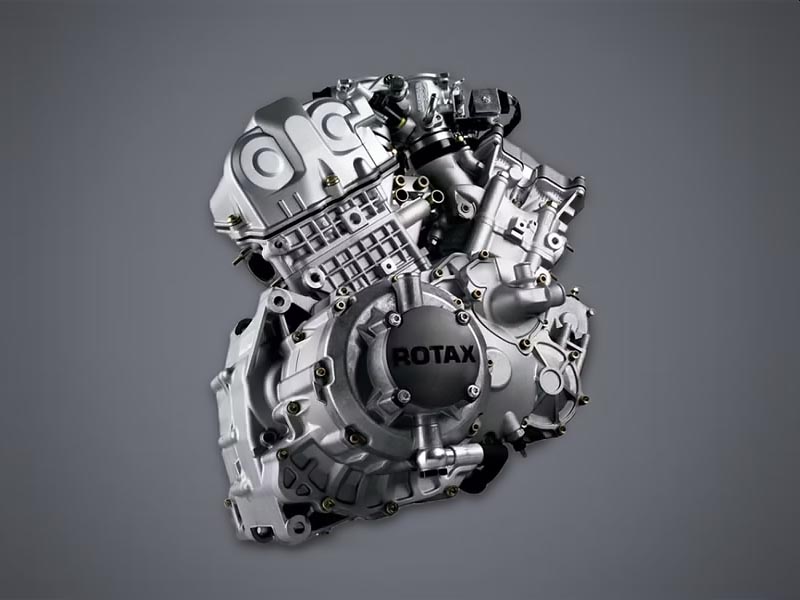
It was also used by Aprilia (under the designation V990) between 1998 and 2003, powering models such as the RSV Mille (1998–2003), RST 1000 Futura (2001–2004), Tuono 1000 (2006–2011), SL1000 Falco (1999–2005) and ETV 1000 Caponord (2001–2012).
Aprilia managed to extract an additional 30 to 40 hp through sport camshafts, higher compression ratio, higher‑flow intake, a larger airbox, a freer exhaust, more aggressive tuning, and a dry‑sump system ideal for more spirited riding.
Can‑Am, on the other hand, chose a more conservative configuration for the Spyder, prioritizing durability and ease of maintenance.
In terms of transmission, the Italians opted for a sporty six‑speed manual gearbox, while the Canadians used a five‑speed gearbox (manual and semi‑automatic) with a longer final drive ratio to ensure lower engine speeds at cruising velocity.
Nevertheless, it is an engine designed for high revs, explosive response and sporty riding.
Technical specifications:
designation | Rotax 998 V‑Twin EFI or Rotax V990 |
type | four‑stroke 60‑degree V‑twin engine |
displacement | 997.62cc |
weight | around 154lb70kg |
cooling | liquid‑cooled |
bore x stroke | 4in97mm × 2.68in68.00mm |
compression ratio | 10.8:1 |
configuration | DOHC, four valves per cylinder (8 total) |
distribuition | chain or belt |
fuel system | multi‑point electronic fuel injection, 2.24in57.00mm throttle body with cable‑operated throttle |
ignition | electronic |
magneto | 500W |
lubrication | dry or wet sump, 5W40 oil |
exhaust | two‑into‑one with catalytic converter |
starter | electric |
power | 100hp @ 7,500rpm to 143hp @ 10,000rpm |
torque | 76.7ft-lb104.0Nm @ 8,000rpm to 79.7ft-lb108.0Nm @ 5,000rpm |
max. rpm | 10,000rpm |
transmission | 5‑speed manual or semi‑automatic with reverse |
maintenance schedule | 3,107mi5,000km or one year |
usage | Can‑Am GS/RS/ST/RT (up to 2013) |
600 ACE
Introduced in 2010, it inaugurated the new generation of ACE (Advanced Combustion Efficiency) engines, focused on efficiency, low friction and optimized combustion. It is a smooth engine designed to reduce operating and maintenance costs. It can start at temperatures as low as -40°C. It debuted in 2011 in Ski‑Doo snowmobiles and Sea‑Doo jet skis. It served as the basis for later engines such as the 900 ACE and 1330 ACE.
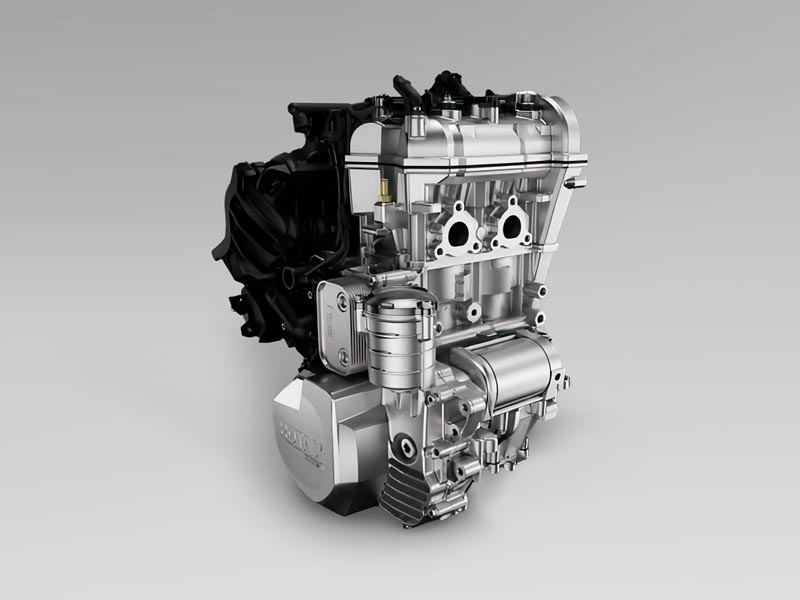
Technical specifications:
designation | Rotax 600 ACE |
type | four‑stroke inline two‑cylinder engine |
displacement | 599cc |
weight | about 88lb40kg |
cooling | liquid‑cooled |
bore x stroke | 2.91in74.00mm × 2.74in69.70mm |
compression ratio | 12:1 |
configuration | DOHC, four valves per cylinder (8 total) |
distribution | chain‑driven |
fuel system | multi‑point electronic fuel injection, 1.85in47.00mm throttle body with electronic throttle (ride‑by‑wire) |
ignition | electronic |
magneto | 400W |
lubrication | dry sump, 5W40 oil |
exhaust | two‑into‑one with catalytic converter |
starter | electric |
power | 50 hp to 60 hp @ 7,250–7,300rpm |
torque | 36.7ft-lb49.7Nm @ 6,000rpm |
redline | 7,800rpm |
transmission | CVT with reverse |
schedule maintenance | 6214mi10000km or one year |
usage | Can‑Am Ryker, Ski‑Doo, Sea‑Doo |
900 ACE
Presented in 2014 to complement the 600 ACE, using the same concept of efficient combustion, smooth operation, and low maintenance. Like the latter, it also debuted in Ski‑Doo snowmobiles and Sea‑Doo jet skis. It exists in two versions — an economical version with about 60hp and a performance version with 90hp. This engine, together with the 600 ACE, has been used in the Can‑Am Ryker since its launch.
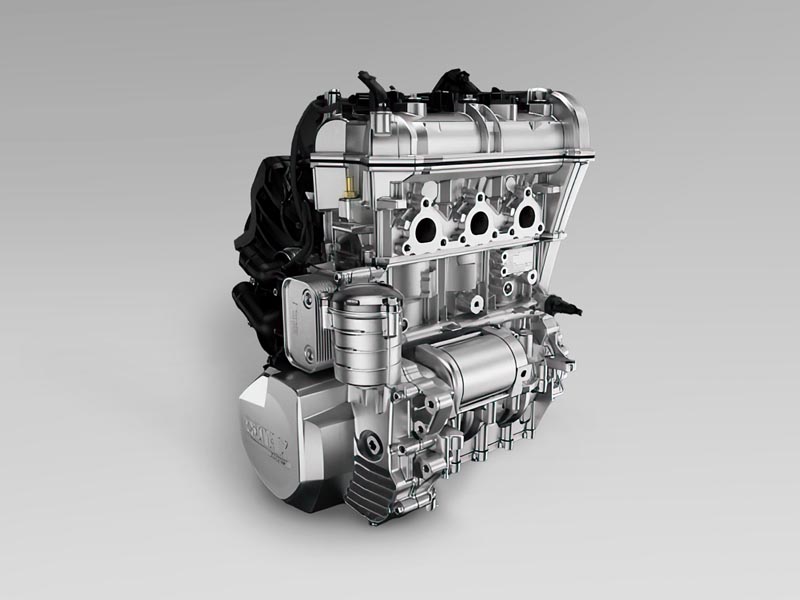
Technical specifications:
designation | Rotax 900 ACE |
type | four‑stroke inline three‑cylinder engine |
displacement | 899cc |
weight | about 123lb56kg |
cooling | liquid‑cooled |
bore x stroke | 2.91in74.00mm × 3.14in79.70mm |
compression ratio | 11.0:1 |
configuration | DOHC, four hydraulic valves per cylinder (12 total) |
distribution | chain‑driven |
fuel system | multi‑point electronic fuel injection, 1.85in47.00mm throttle body with electronic throttle (ride‑by‑wire) |
ignition | electronic, dual‑coil |
magneto | 400W |
lubrication | dry sump, 5W40 oil |
exhaust | three‑into‑one with catalytic converter |
starter | electric |
power | 60hp or 90hp @ 8,000 rpm |
torque | 53.5ft-lb72.6Nm @ 4,000rpm |
redline | 7,000rpm (60hp) or 8,000rpm (90hp) |
transmission | CVT with reverse |
maintenance schedule | 6214mi10000km or one year |
usage | Can‑Am Ryker, Ski‑Doo, Sea-Doo |
1330 ACE
This engine appeared in the mid‑2000s under the ACE (Advanced Combustion Efficiency) designation, following the same philosophy of reducing operating and maintenance costs.
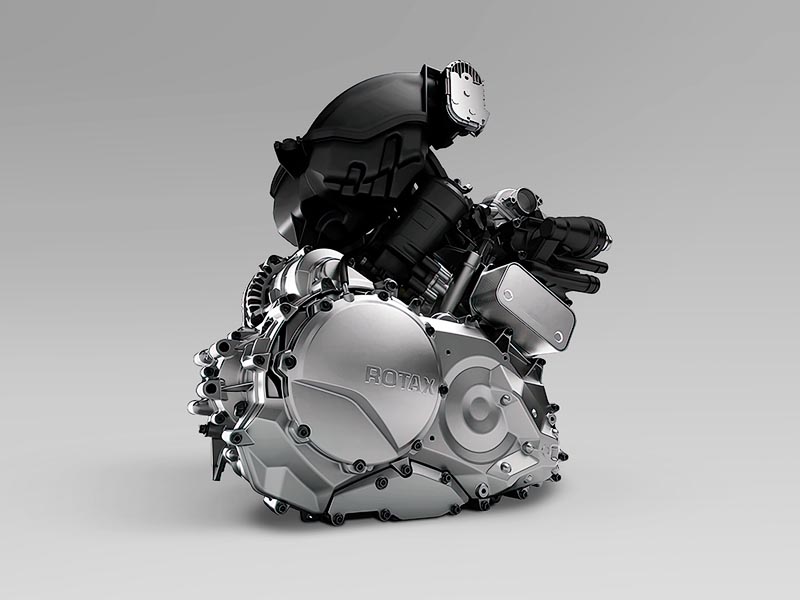
It incorporates an electronic ride‑by‑wire throttle that allows real‑time fuel‑injection management.
It uses a dry‑sump system which, given the large displacement (+25% compared to the 998), helps reduce its overall volume.
It features hydraulic valves that adjust automatically and require no regular valve clearance adjustments.
It surpasses the 998 in several aspects: more power, more torque, better fuel optimization (thermal management and control), longer and less expensive maintenance intervals, reduced vibration (thanks to the inline‑three architecture versus the V‑twin), and overall greater reliability and robustness.
All these attributes make it an excellent evolution for the Spyder, which, especially with the launch of the RT line, became more oriented toward touring.
Technical specifications:
designation | Rotax 1330 ACE |
type | four‑stroke inline three‑cylinder engine |
displacement | 1330 cc |
weight | around 247lb112kg |
cooling | liquid‑cooled |
bore x stroke | 84mm × 80mm |
compression ratio | 12:1 |
configuration | DOHC, four hydraulic valves per cylinder (12 total) |
distribution | chain‑driven |
fuel system | multi‑point electronic fuel injection, 54mm throttle body with electronic throttle (ride‑by‑wire) |
ignition | electronic, dual‑coil |
magneto | 650W |
lubrication | dry sump, 5W40 oil |
exhaust | three‑into‑one with catalytic converter |
starter | electric |
power | 115hp @ 7,250rpm |
torque | 95.9ft-lb130.0Nm @ 5,000rpm |
max. rpm | 8,100rpm |
transmission | 6‑speed manual or semi‑automatic with reverse |
maintenance schedule | 9,321mi15,000km or one year |
usage | Can‑Am F3/RT (from 2014 onward) |
PU 3520 E-POWER
Little is known about this electric motor that powers the Pulse and Origin motorcycles. It is cleverly mounted on the swingarm and integrated into the cooling system that also includes the battery, inverter and onboard charger.
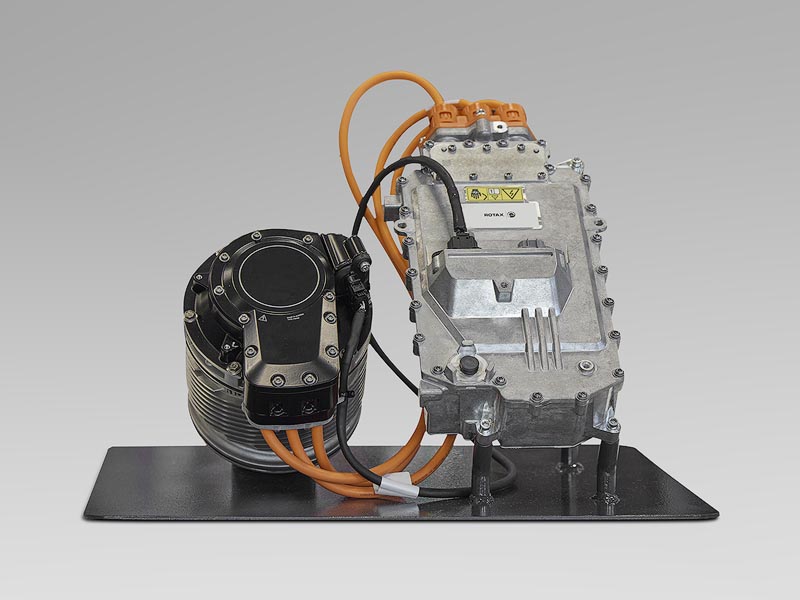
Technical specifications:
designation | Rotax PU 3520 E-POWER |
type | electric, PMSM (Permanently excited Synchronous Motor) |
weight | around 26lb12kg |
cooling | liquid |
power | 48hp (35kW) peak, 27hp (20kW) continuous |
torque | 53ft-lb72Nm @ 0-4,600rpm |
max. rpm | 12,000rpm |
transmission | none |
usage | Can-Am Pulse and Origin |
Any missing or incorrect information, please leave a message below
Leave a message