Spyder technical
The fact that it has two wheels at the front gives it several advantages. It allows for more powerful and better‑distributed braking (all vehicles apply greater braking force at the front) and provides stable, precise steering.
All Spyder models use a three‑wheel ABS braking system operated centrally by the pedal under the right foot; there is no brake lever as on motorcycles.
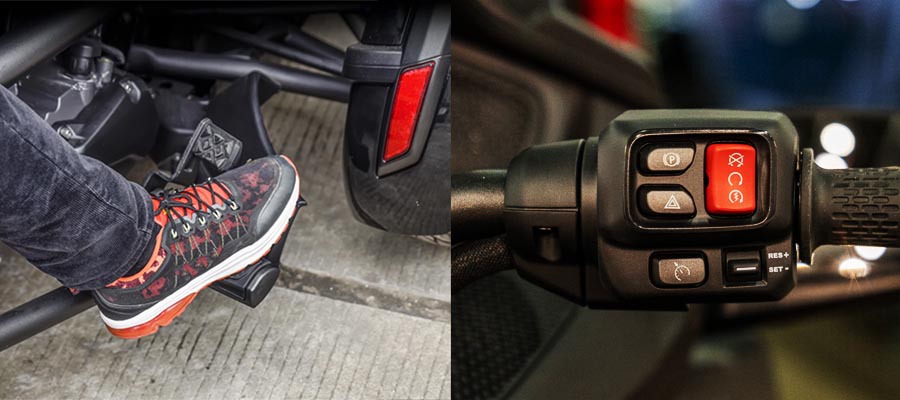
Parking is secured by a rear‑wheel parking brake, activated by an electric button on the handlebar/console or by a pedal (left side) on the RS.
The front wheels are mounted on an independent double‑wishbone suspension system (very common in the automotive industry) with a stabilizer bar, and the steering is electrically assisted (Dynamic Power Steering).
It includes rider‑assistance systems such as Anti‑lock Braking System (ABS), Traction Control System (TCS), Stability Control System (ESC) and a global Vehicle Stability System (VSS) that combines all previous systems to keep the three wheels on the ground and on their intended trajectory.
The ST‑S/ST Limited, the F3 line (except the base version), and the RT line offer cruise control operated from the handlebar.
The rear suspension is a swingarm with a mono‑shock. There is no preload adjustment on the RS, F3, and F3‑S versions; the F3‑T has manual leveling, and the F3 Limited and all RT versions feature automatic leveling. The leveling system (Active Suspension System) uses an airbag around the shock absorber whose pressure can be adjusted via a valve (manual leveling) or through a compressor that automatically maintains the selected firmness (auto‑leveling).
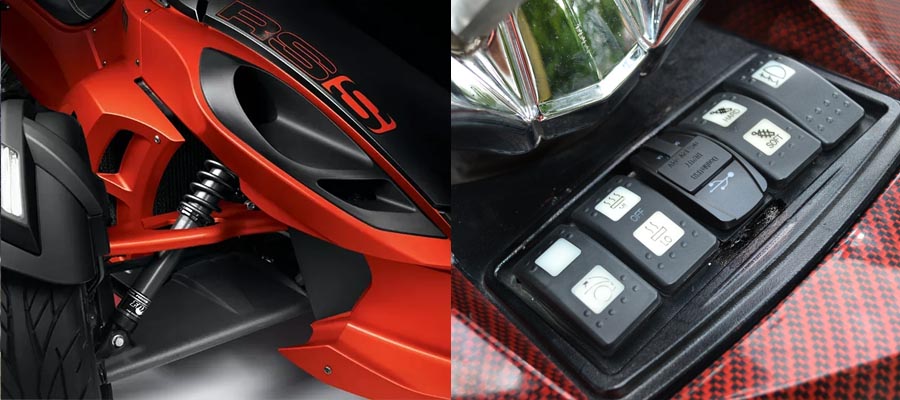
The RS/ST (from 2014 onward) and F3‑S (until 2021) versions receive FOX Podium and KYB (2022–2023 F3‑S) sport suspensions at the front. From 2024 onward, the entire F3 line uses the standard SACHS suspension.
The primary transmission may have five gears (with the 998 V‑Twin engine) or six gears (with the 1330 ACE engine), and can be manual (until 2018 on the F3‑S) or semi‑automatic. The manual gearbox (SM5/SM6) operates like a motorcycle, with a clutch lever and a foot shifter on the left. The semi‑automatic gearbox (SE5/SE6) works as a sequential transmission with a paddle on the handlebar to upshift or downshift. Shifts are fast and automated, with no need to roll off the throttle. Everything happens in milliseconds. Downshifts are performed automatically below a certain RPM, but can be triggered manually at any time.
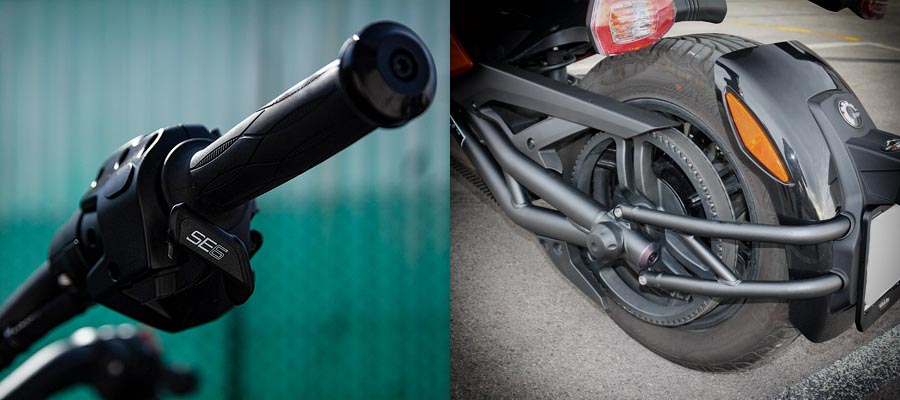
The secondary transmission uses a carbon‑fiber‑reinforced belt coated in polyurethane for protection against water, oil, and heat.
An ECO riding mode is available, limiting throttle response to reduce fuel consumption, and a Sport mode is available on the sportier F3‑S versions (from 2017 onward), reducing VSS intervention to allow faster and more aggressive riding.
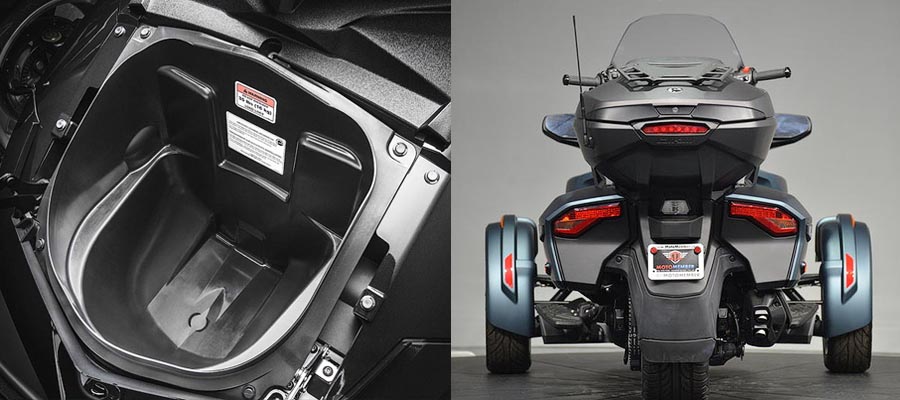
All Spyder models offer a front storage compartment capable of holding a small backpack or a full‑face helmet. The RT version increases total cargo capacity to an impressive 47gal(US)177l (RT from 2020 onward).
Technical specifications of the model and various lines:
Spyder GS/RS/RS‑S/ST/ST‑S/ST Limited | Spyder F3/F3‑S | Spyder F3‑T/F3 Limited | Spyder RT/RT Limited | |
|---|---|---|---|---|
years | GS 2008..2009 | F3 2015...2023 | RT 2010...2020... | |
engine | Rotax 998 V‑Twin (2‑cylinder V‑twin) | Rotax 1330 ACE (inline 3‑cylinder) | Rotax 998 V‑Twin (2‑cylinder V‑twin) ≤2013 or | |
power | 106hp (79kW) @ 8500rpm | 105hp (78.3kW) (F3) or | 115hp (85.8kW) @ 7250rpm | 106hp (79kW) @ 8500rpm (Rotax 998 V‑Twin) or |
torque | 76.9ft-lb104.3Nm @ 6250rpm | 95.9ft-lb130.0Nm @ 5000rpm | 76.9ft-lb104.3Nm @ 6250rpm (Rotax 998 V‑Twin) or | |
performance* | 112mph180km/h, 4.5s (RS) | 124mph200km/h, 5.2s (F3) | 118mph190km/h, 5.5s (F3‑T) | 109mph175km/h, 5.6s (RT ≤2013) |
*there are no official performance values, the above figures are estimate | ||||
fuel consumption | 33.6mpg(US)7.0l/100km | 37.3mpg(US)6.3l/100km | 31.4mpg(US)7.5l/100km (RT ≤2013) | |
transmission | 5‑speed semi‑automatic (SE5) or | 6‑speed semi‑automatic (SE6) or | 5 or 6‑speed semi‑automatic (SE5/SE6) or manual (SM5/SM6) with reverse | |
final drive | carbon‑fiber‑reinforced belt with polyurethane coating | |||
final ratio | 79/28 | |||
battery | 12V, 21Ah, 350A CCA (Yuasa YTX24HL‑BS) | |||
magneto | 500W | 650W | ||
curb weight | 699lb317kg | 899lb408kg | 948lb430kg (F3‑T), | 1012lb459kg–1027lb466kg (RT ≤2019), |
dimensions | 105.0in2667.0mm × 59.3in1506.0mm × 45.1in1145.0mm | 104.0in2642.0mm × 58.9in1497.0mm × 43.3in1099.0mm | 102.2in2596.0mm × 58.9in1497.0mm × 48.9in1241.0mm (F3‑T), | 105.4in2677.0mm × 61.9in1572.0mm × 59.4in1510.0mm (≤2019), |
wheelbase | 68.0in1727.0mm | 67.3in1709.0mm | 67.4in1711.0mm (≤2019), | |
ground clearance | 4.5in115.0mm | |||
seat height | 29.0in737.0mm | 26.6in675.0mm | 30.4in772.0mm | |
rider aids | power steering (DPS), traction control (TCS), vehicle stability (VSS), stability control (SCS), anti‑lock braking (ABS), hill‑hold control (HHC) ≥2021 | |||
safety | anti‑theft system (DESS), electric rear‑wheel parking brake | |||
front suspension | independent double‑wishbone with stabilizer bar and SACHS or FOX shock | independent double‑wishbone with stabilizer bar and | independent double‑wishbone with stabilizer bar and SACHS shock | |
rear suspension | swingarm with SACHS mono‑shock | swingarm with SACHS mono‑shock | swingarm with SACHS leveling mono‑shock (F3‑T)/ | swingarm with SACHS self‑leveling mono‑shock |
front brakes | (2×) 250mm disc with 4‑piston caliper | (2×) 270 from: mm to: in round: 1 decimal: .) disc with fixed Brembo 4‑piston caliper | ||
rear brake | 250mm disc with single‑piston caliper | 270 from: mm to: in round: 1 decimal: .) disc with floating Brembo single‑piston caliper | ||
front tires | (2×) 165/65 R14 47H (15 PSI) | 165/55 R15 (20 PSI) | ||
rear tire | 225/50 R15 76H (28 PSI) | |||
instrumentation | analog and digital | analog and digital | digital | digital |
fuel tank | 6.6gal(US)25.0l | 7.1gal(US)27.0l | 6.6gal(US)25.0l | |
payload capacity | 441lb200kg | 439lb199kg (F3/F3‑S/F3‑T) | 494lb224kg | |
towing capacity | 399lb181kg (ST versions) | 401lb182kg | ||
cargo volume | 11.6gal(US)44.0l | 6.4gal(US)24.4l | 20.6gal(US)78.0l (F3‑T), | 40.9gal(US)155.0l (≤2019), |
additional cargo volume | 27.2gal(US)103.0l, 3 Givi cases | 35.4gal(US)134.0l, 3 SHAD cases | 15.3gal(US)58.0l, 1 SHAD case | |
Official technical brochures:
2008 Can‑Am Spyder specifications GS.
2009 Can‑Am Spyder specifications GS.
2010 Can‑Am Spyder specifications RS, RT.
2011 Can‑Am Spyder specifications RS, RT.
2012 Can‑Am Spyder specifications RS, RT.
2013 Can‑Am Spyder specifications RS, ST, RT.
2014 Can‑Am Spyder specifications RS, ST, RT.
2015 Can‑Am Spyder specifications RS, ST, RT, F3/F3‑S.
2016 Can‑Am Spyder specifications RS, ST, RT, F3/F3‑S, F3‑T/F3 Limited.
2017 Can‑Am Spyder specifications RT, F3‑S, F3‑T, F3 Limited.
2018 Can‑Am Spyder specifications RT, F3/F3‑S, F3‑T, F3 Limited.
2019 Can‑Am Spyder specifications RT, RT Limited, F3, F3‑S, F3‑T, F3 Limited.
2020 Can‑Am Spyder specifications RT, RT Limited, F3, F3‑S, F3‑T, F3 Limited.
2021 Can‑Am Spyder specifications RT, RT Limited, RT Sea‑to‑Sky, F3, F3‑S, F3‑T, F3 Limited.
2022 Can‑Am Spyder specifications all models.
2023 Can‑Am Spyder specifications all models (EMEA).
2024 Can‑Am Spyder specifications all models, all models (EMEA).
2025 Can‑Am Spyder specifications all models, all models (EMEA).
2026 Can‑Am Spyder specifications all models.
Any missing or incorrect information, please leave a message below
Leave a message